English

Views: 0 Author: Site Editor Publish Time: 2026-02-25 Origin: Site


Ever wondered why transformers can’t convert DC voltage? It’s a common question for anyone working with electrical systems. While transformers are essential for AC circuits, they simply don’t work with DC.
In this post, we’ll explore why transformers are designed to handle alternating current (AC) only, and not direct current (DC). You’ll learn the science behind electromagnetic induction and the limitations when applying DC voltage. Plus, we’ll introduce SNTOOM, a leading transformer manufacturer specializing in AC-based transformer products.
Transformers work based on Faraday’s Law of Electromagnetic Induction, which explains how electrical energy is transferred through the transformer. Here’s a simplified breakdown:
● Changing Magnetic Field: When an alternating current (AC) flows through the primary coil of a transformer, it generates a fluctuating magnetic field in the core.
● Induced Voltage: This changing magnetic field induces an electromotive force (EMF) in the secondary coil, which then transfers energy to the secondary circuit.
The key here is the fluctuation of the magnetic field. Only AC current can produce these fluctuations, which is why transformers are designed to work with AC circuits.
For instance, SNTOOM transformers utilize this principle across various industrial scenarios, such as high-voltage equipment and motor drives, where a consistent AC voltage needs to be stepped up or stepped down. This method is efficient and reliable, ensuring safe and stable operation in different environments.
Unlike AC, direct current (DC) does not fluctuate. This lack of fluctuation in DC current creates significant issues for transformers:
● Constant Magnetic Field: When DC is applied to the primary coil, it creates a constant magnetic field in the transformer core. This is very different from AC, where the magnetic field continually changes.
● No Induced EMF: Since Faraday’s law requires a changing magnetic field to induce voltage in the secondary coil, a constant magnetic field from DC does not induce any voltage. This means DC fails to activate the transformer’s core principles, leaving the secondary coil with no induced electromotive force (EMF).
In SNTOOM transformers, only AC voltage can effectively induce EMF in the secondary coil. When DC is used, there is no voltage transfer, meaning the transformer is unable to fulfill its intended function. This is why DC systems require different types of equipment, such as DC-DC converters or inverters, to convert and regulate voltage.
With transformers specifically designed for AC circuits, trying to use DC input can result in wasted energy, overheating, and potential damage to the transformer’s core and windings. Understanding these operational limits ensures that the right solutions are chosen for your electrical systems, avoiding costly mistakes and ensuring efficiency.
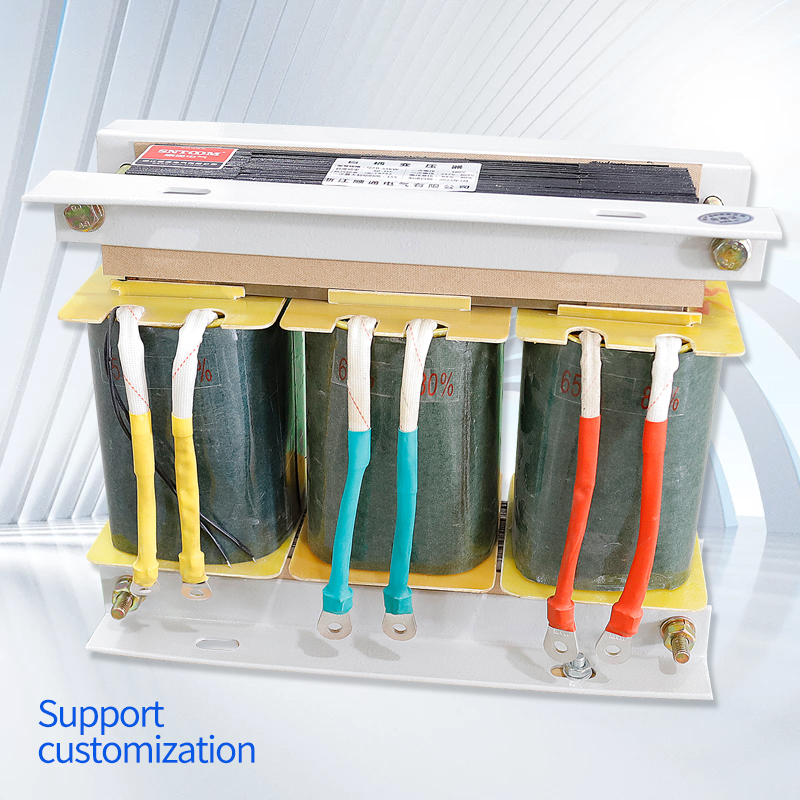
Transformers rely on electromagnetic induction to transfer energy. This process depends on the constant change in the magnetic field. In an alternating current (AC) system, the current fluctuates direction and magnitude, creating a fluctuating magnetic field in the transformer’s core. This fluctuation is essential for inducing voltage in the secondary coil.
However, direct current (DC) is constant—it does not change direction or magnitude. This static nature of DC means there is no fluctuation in the magnetic field. Without this fluctuation, the transformer cannot induce any voltage in the secondary coil, making DC unsuitable for use in transformers.
● Critical Point: Transformers are designed to operate with fluctuating magnetic fields, a condition not met by DC. This is why transformers are ineffective when used with DC circuits.
Another issue with using DC in transformers is core saturation. When DC is applied, the transformer’s core becomes magnetized to a constant level. Since the magnetic field is not changing, the core can quickly reach its saturation point. Once the core is saturated, it can no longer carry additional magnetic flux, which drastically reduces the transformer’s efficiency.
● Result of Core Saturation: With DC, the transformer loses its ability to transfer energy effectively. This leads to a loss of functionality and could cause damage due to excessive current.
This situation can be especially problematic for high-quality transformers, such as SNTOOM’s models. If DC is used incorrectly, it could lead to transformer failure, especially if the core saturation results in overheating or insulation breakdown.
When DC is applied, it flows continuously through the primary coil. Unlike AC, which has inductive reactance to limit the current, DC faces no such restrictions. The result is excessive current flowing through the transformer’s windings. This constant current flow generates significant heat.
● Impact on Transformer Windings: Without the limiting effect of inductive reactance, the constant current in a DC circuit can cause the windings to overheat. Prolonged overheating can lead to insulation failure and permanent damage to the transformer.
Fortunately, SNTOOM’s transformers are designed with high-quality materials and efficient insulation systems to minimize the risks associated with overheating. Under correct operating conditions, these transformers are built to handle AC fluctuations without experiencing the same issues as DC circuits.
When it comes to converting DC voltage levels, DC-DC converters are the go-to solution. These devices use switching circuits to adjust the voltage from one level to another. Whether you need to step up (boost) or step down (buck) the voltage, DC-DC converters can efficiently manage the process by rapidly switching the DC voltage on and off.
● How They Work: By alternating the flow of DC at high frequencies, DC-DC converters generate pulses that are then filtered and adjusted to the desired voltage level.
● SNTOOM’s Role: SNTOOM’s high-frequency transformers complement DC-DC converters in industrial systems, helping to manage high-frequency AC conversion. They provide stable energy transfer after the DC voltage has been processed, ensuring safe and reliable voltage adjustments for various industrial applications.
Inverters are another key alternative for DC voltage conversion. Unlike DC-DC converters, inverters convert DC into alternating current (AC). This process is essential for systems that require AC voltage, such as in power distribution or motor control systems.
● How Inverters Work: An inverter takes DC voltage and uses switching components to generate an AC output. This AC can then be stepped up or stepped down using traditional transformers.
● SNTOOM’s Transformers: After the DC is converted to AC, SNTOOM’s high-frequency transformers step up or step down the voltage as needed. This combination allows for the efficient use of AC systems even when DC sources are involved.
In many systems, DC-DC converters and transformers can work together to provide efficient voltage conversion and regulation. The DC-DC converter adjusts the DC voltage to a more suitable level, and then transformers like SNTOOM’s high-frequency models can further refine the voltage for specific industrial needs.
● The Process: First, the DC voltage is converted using the DC-DC converter. Then, the transformer adjusts this AC voltage to either step it up or down, depending on system requirements.
● Example: In SNTOOM’s systems, this combination is commonly used in high-voltage applications, ensuring that systems with DC power sources can integrate seamlessly into industrial AC-powered infrastructures.
Alternative | Function | Role of SNTOOM Transformers |
DC-DC Converters | Convert DC voltage levels | Complemented by high-frequency transformers for efficient AC conversion |
Inverters | Convert DC to AC | High-frequency transformers step AC voltage up or down post-conversion |
Combining Both | Efficient voltage regulation | Transformers help fine-tune voltage after DC-DC conversion or AC conversion |

Selecting the right transformer is critical to the efficient and safe operation of an AC power system. Transformers come in various types, and choosing the right one requires considering several important factors based on your specific system needs. Let’s dive deeper into the key points:
● Voltage Matching: The primary and secondary voltage ratings of the transformer must be matched with the power system. For example, if your system runs at 380V and you need to step down to 220V, selecting a transformer with the correct turns ratio is crucial. Using a transformer with improper voltage ratings can lead to inefficiencies or even equipment failure.
● Current Handling: Transformers need to be rated for the current they will carry. A transformer rated for a lower current than required may overheat, leading to premature failure or dangerous situations. Conversely, a transformer rated for much higher current than needed could lead to wasted energy and unnecessary costs.
● Phase Matching: AC power systems are typically either single-phase or three-phase. The transformer you select must match the number of phases in your system. For industrial applications requiring higher loads, a three-phase transformer will be essential to ensure efficiency and prevent system overload.
When it comes to SNTOOM’s transformers, their three-phase transformers are perfect for large systems needing consistent and efficient power distribution. These transformers are designed to handle the complex voltage and current requirements of industrial equipment, ensuring seamless operation and durability. Additionally, SNTOOM’s voltage regulators maintain a steady voltage level, ensuring that sensitive equipment and machinery function smoothly without power fluctuations.
While transformers are indispensable in AC systems, they do not work with DC systems. Applying DC to a standard transformer will lead to significant issues, and here’s why:
● No Magnetic Field Fluctuation: Transformers operate based on electromagnetic induction, which requires a changing magnetic field. AC provides this fluctuation, while DC remains constant. Since DC doesn’t induce a varying magnetic field, transformers fail to transfer energy from the primary to the secondary winding.
● Core Saturation: When DC is applied to the transformer, the core quickly becomes saturated. In a saturated state, the transformer cannot transfer energy efficiently, and this leads to system inefficiencies. Prolonged exposure to DC could even damage the core of the transformer, rendering it useless.
● Heat Generation and Damage: In an AC circuit, the inductive reactance of the transformer limits the current flow. However, with DC, there is no inductive reactance, leading to an excessive, constant flow of current through the transformer’s windings. This causes the transformer to overheat, potentially damaging the winding insulation and other critical components.
For DC voltage systems, the solution lies in DC-DC converters. These devices are specifically designed to handle voltage changes in DC systems. They operate by converting the DC input into a high-frequency AC before adjusting the voltage, then converting it back into DC. This method ensures that DC systems can efficiently manage power without relying on transformers.
SNTOOM provides specialized products like high-frequency transformers that complement DC-DC converters in DC applications. These transformers are used in combination with DC-DC converters to manage high-frequency AC during the voltage adjustment process, ensuring reliable operation even in systems that require DC power.
Transformer Type | Best for | SNTOOM’s Products |
Three-phase transformers | Large industrial AC power systems | Perfect for high-voltage applications, ensuring reliable energy transfer for heavy-duty machinery |
Voltage regulators | Maintaining stable voltage for sensitive equipment | Used in demanding industrial setups, ensuring smooth operation without power fluctuations |
High-frequency transformers | Complementing DC-DC converters for DC systems | Ensures safe AC conversion and voltage regulation in DC circuits when used with DC-DC converters |
Transformers are designed for AC systems and cannot directly convert DC voltage due to their reliance on fluctuating magnetic fields. For DC systems, DC-DC converters and inverters are the ideal solutions. SNTOOM's high-frequency transformers still play a vital role in supporting these conversions. When selecting equipment for DC systems, it’s essential to choose devices that ensure both efficiency and safety.
A: No, transformers do not work with DC current because DC does not produce the fluctuating magnetic field required for electromagnetic induction. However, transformers can be used in circuits where AC components are involved.
A: Transformers are not suitable for direct DC conversion, but they can support DC systems when used in combination with devices like DC-DC converters or inverters, which convert DC to AC for proper voltage adjustment.
A: No, transformers cannot convert DC voltage to AC voltage. They require alternating current (AC) to function, as the magnetic field needs to fluctuate for energy transfer.
A: DC is harmful because it causes the transformer core to saturate quickly, leading to inefficiencies and potential damage from excessive current and heat generation.
A: Applying DC to a transformer for an extended period can lead to core saturation, overheating, and potential failure due to constant current flow, which transformers are not designed to handle.