English

Views: 0 Author: Site Editor Publish Time: 2026-02-25 Origin: Site


Surge current describes a sudden increase in electrical flow that can threaten your safety and damage your devices. You face risks every time a power surge hits your home or business. These surges may come from lightning, grid switching, or large appliances turning on and off. When voltage spikes, your electronics can fail, and you may experience costly downtime. Surge protection helps keep your equipment safe and reliable.
Modern solutions, such as Variable Frequency Drives (VFDs), offer advanced protection by managing surge and reducing damage.
You may notice your lights flicker or your electronics reset suddenly. This can happen when a surge current flows through your electrical system. Surge current is a sudden, sharp increase in electrical flow. It often happens when you turn on large appliances, or when a lightning strike causes a power surge. Unlike the steady current that powers your devices every day, surge current appears as a quick spike. You might not see it, but it can damage sensitive equipment or even cause fires.
Surge current can enter your home or business from outside sources, such as lightning or issues with the power grid. It can also come from inside, like when motors or compressors start up. You need to understand surge current because it can lead to expensive repairs and lost data. Many people do not realize how quickly a power surge can harm their electronics.
Tip: Installing surge protection devices helps you guard against these sudden spikes and keeps your equipment safe.
You might wonder how surge current differs from the normal current that runs through your wires. The main difference is in how each behaves. Normal current flows steadily and keeps your devices running smoothly. Surge current, on the other hand, is unpredictable and much stronger for a brief moment.
Here is a table that highlights the key differences:
Characteristic | Surge Current | Normal Current |
|---|---|---|
Nature | Sudden and substantial increase | Steady flow during operation |
Peak Value | Can be several times higher | Consistent and stable |
Activation | Observed as an initial spike | Continuous flow without spikes |
When a power surge occurs, the surge current can reach levels far above what your devices can handle. This is why you need to pay attention to both the steady flow and the sudden spikes in your electrical system. By understanding these differences, you can take steps to protect your home or business from the risks of surge current.
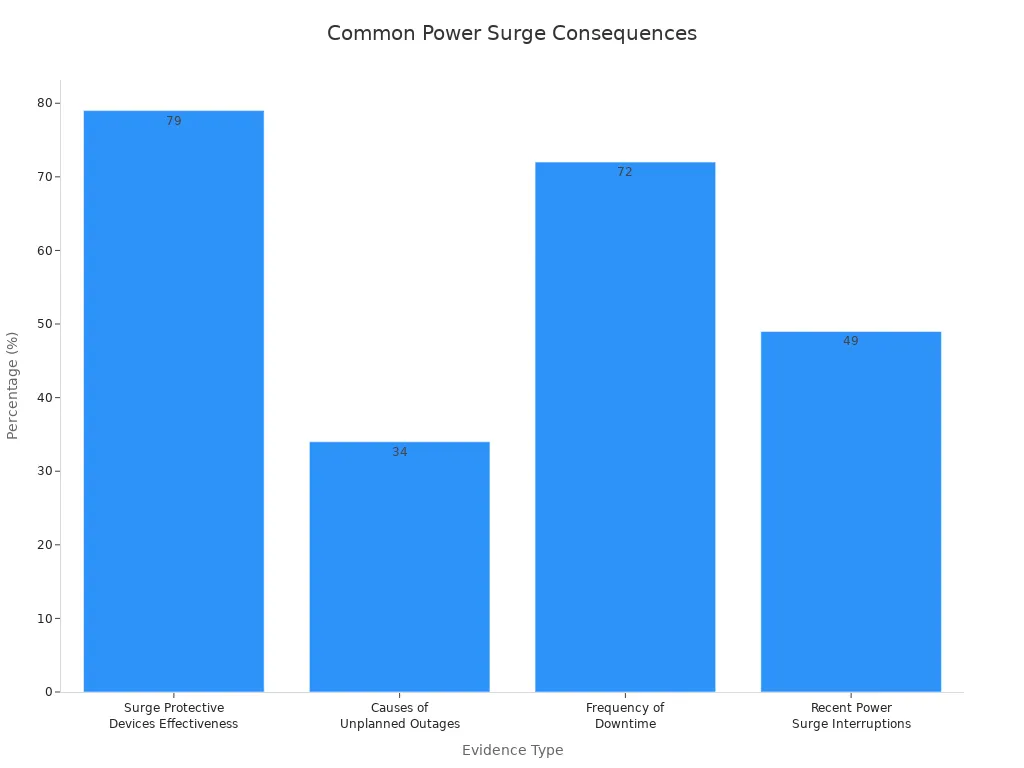
You may not realize that many power surges start inside your own building. When you turn on large equipment, such as printers, air conditioning units, or electric motors, you create a sudden demand for electricity. This demand can cause a voltage spike or electrical overload. These events often lead to flickering lights or even errors in sensitive devices.
Other common sources of surge current include:
Equipment load cycling, which happens when machines start and stop during normal operation.
Short circuits that can send a high power surge through your wiring.
Loose wire connections that make your system unstable.
Damaged electrical wiring, which increases the risk of electrical overload.
Line noise from electromagnetic interference, which can cause transients and voltage spikes.
You should check your wiring and equipment often. This helps you prevent a significant power surge from damaging your devices.
You also face risks from outside your building. Extreme weather events often cause power surges that affect entire neighborhoods. The table below shows how different weather conditions impact power infrastructure:
Extreme Weather Event | Impact on Power Infrastructure |
|---|---|
High Winds | Stress on above-ground lines |
Heavy Rain | Potential flooding |
Ice | Damage to power lines |
Lightning | Risk of surges |
Extreme Heat | Increased demand on systems |
Lightning can cause a sudden voltage spike that travels through the grid. High winds and ice may damage power lines, leading to electrical overload or blackouts. During heat waves, you may see a 60% increase in blackouts, which can trigger a significant power surge when the power returns. These external factors show why you need to protect your home or business from transients and voltage spikes.
You rely on many types of equipment every day, from computers to refrigerators. Surge current can cause serious damage to these devices. When a power surge happens, the electrical flow can spike far above what your equipment can handle. This sudden increase may force your devices to restart or slow down. Over time, repeated surges can wear out the parts inside your electronics. You might not notice the effects right away, but the damage builds up. Sensitive electronic devices often age faster when exposed to surge current. Their operational lifespan gets shorter, and you may face unexpected failure much sooner than you expect.
If you see your equipment acting strangely, such as random restarts or error messages, you could be seeing the results of surge current damage. Even small surges can weaken the circuits inside your devices. You may need to replace your equipment more often, which increases your costs and wastes resources. Protecting your devices from power surges helps you avoid these problems and keeps your equipment running longer.
Tip: Use surge protection devices to shield your valuable equipment from sudden electrical spikes.
Surge current does not only affect individual devices. It can also threaten the reliability of entire electrical systems. When a surge hits, you may see immediate catastrophic damage, such as complete failure of equipment. Sometimes, the damage is not obvious right away. Devices might keep working, but hidden problems build up inside. Over time, these hidden issues can lead to sudden failure, causing downtime and expensive repairs.
You should know that power surges combine high voltage, high current, and long duration. This combination puts a lot of stress on your electrical systems. The risks include:
Catastrophic failure, where equipment stops working completely due to thermal or mechanical damage.
Latent failure, where equipment seems fine but fails later because of stress from earlier surges.
Increased stress on electrical components, making your systems less reliable over time.
If you want your electrical systems to stay reliable, you must protect them from surge current damage. Regular checks and proper surge protection can help you avoid costly failure and keep your equipment safe.

You need to understand how surge protection devices work to keep your equipment safe. These devices act as barriers that stop dangerous surges from reaching your valuable electronics. You can find different types of surge protection devices, each designed for a specific location in your electrical system. The table below shows the main types and their roles:
Type of SPD | Installation Location | Purpose | Key Characteristics |
|---|---|---|---|
Type 1 | Service entrance | Direct lightning strikes and high-energy surges | Withstands high current, handles 10/350 µs waveforms, current ratings over 25 kA |
Type 2 | Distribution panels | Indirect lightning strikes and switching surges | Tested with 8/20 µs waveforms, lower clamping voltages |
Type 3 | Point-of-use | Final defense for sensitive equipment | Installed within 10 meters of equipment, minimizes lead impedance effects |
Type 1 surge protection devices protect your building from a lightning strike or large power surges at the service entrance. Type 2 devices go in distribution panels to block surges from switching operations or indirect lightning. Type 3 devices, also called transient voltage surge suppressors, sit close to your sensitive equipment and act as the last line of defense.
You should always look for surge protection devices that meet industry standards. For example, UL 1449 certification ensures the device can handle the rated voltage and current. Devices must connect to each ungrounded conductor and match your system’s voltage. If you use data communications or need electromagnetic interference filters, make sure your protectors meet UL 497B and UL 1283 standards.
Tip: Layering different types of surge protection devices gives you the most effective surge protection for your equipment.
You need to choose the right surge protectors for your home or business. The best choice depends on your application and the level of risk. The table below compares recommendations for residential and commercial use:
Application Type | Recommended Surge Protector Types |
|---|---|
Residential | Type 2 at main panel, Type 3 for sensitive electronics |
Commercial | Type 1 at service entrance, Type 2 at distribution panels, Type 1, 2, and 3 for critical facilities |
For homes, you should install a Type 2 surge protector at the main panel. Add Type 3 protectors for computers, TVs, and other sensitive equipment. In commercial buildings, use Type 1 devices at the service entrance to block large surges. Place Type 2 protectors at distribution panels and add extra layers for critical equipment.
Whole-house surge protectors, also known as whole home arresters, give you comprehensive defense. They protect all outlets and appliances from both high and low voltage surges, including those caused by a lightning strike or cycling of large appliances. Plug-in surge protectors only guard against small surges and protect devices plugged directly into them. They do not cover hardwired equipment or large systems.
You should not rely on circuit breakers alone. Circuit breakers trip on current, not voltage, so they do not stop a power surge from damaging your equipment. Many people think power strips with surge protection are enough, but these only protect a few devices and have limited capacity. Surge protectors have a limited lifespan and need replacement after absorbing surges.
Modern trends show a shift toward smart surge protection devices. These devices can communicate with other systems and provide real-time data. As more homes and businesses use renewable energy and automation, the need for effective surge protection grows.
You can also use advanced solutions like the AC Motor Control Energy Efficiency Variable Frequency Drive from Zhejiang Shuntong Electric Co., Ltd. This VFD reduces surge current during motor startup, which protects connected equipment from damage. It controls startup current, lowers mechanical stress, and extends the life of your motors. The VFD includes overcurrent and overvoltage protection, making it a strong choice for industrial systems. It also offers real-time diagnostics, so you can monitor motor speed, current, voltage, and temperature. These features help you spot problems early and prevent power surges from causing costly downtime.
Note: Investing in surge protectors and advanced equipment like VFDs can save you money by extending equipment lifespan, lowering maintenance costs, and avoiding emergency repairs.
You must maintain and monitor your surge protection system to keep your equipment safe. Surge protectors do not last forever. They wear out as they absorb surges, so regular checks are important. Follow these best practices for maintenance:
Schedule inspections of your surge protection devices at least every five years.
Inspect your system immediately after any suspected lightning strike or major electrical event.
Keep records of all inspections and maintenance, and have a certified electrician perform these checks.
For lightning protection systems, inspect surge protectors at least every 12 months or whenever you test the system.
You should also check the indicator lights on your surge protectors. If the light goes out or changes color, replace the device. Visually inspect for physical damage, especially after storms. Call a licensed electrician if you see any problems.
For businesses, grounding is critical. A low-resistance grounding system diverts high-current surges safely to the ground. Train your employees on safe power usage and surge protection measures. Use one device per outlet to avoid overloading circuits. Unplug equipment during storms if it is safe. Report any electrical issues to maintenance right away.
Advanced surge protection devices and VFDs now include diagnostic features. You can monitor motor speed, current, voltage, and temperature. These diagnostics help you find problems before they cause damage. You can access this information on the device or remotely, which makes maintenance easier and faster.
Tip: Layer your surge protection, keep up with inspections, and use smart monitoring to ensure effective surge protection for all your equipment.
You now understand why surge current awareness matters for electrical safety. Surge protection keeps your equipment safe and your systems running. Consider these key benefits:
Protects valuable equipment and extends device lifespan
Reduces operational downtime and prevents data loss
Enhances safety and meets international standards
Proactive surge protection lowers costs and keeps your business moving:
Description | Impact |
|---|---|
Diverts transient energy from sensitive components | Maintains uptime and reduces replacement |
Invests in high-quality surge protection | Extends lifespan and lowers costs |
You can also use VFDs to improve surge protection and energy efficiency. VFDs ramp up motor speed gradually, reduce mechanical stress, and minimize energy waste.
A surge protector shields your devices from sudden voltage spikes. It diverts excess energy away from your electronics, keeping them safe from damage.
You should check your surge protectors every few years. Replace them after a major surge or if the indicator light goes out.
Yes. A VFD, like the one from Zhejiang Shuntong Electric Co., Ltd., controls motor startup and reduces surge current. It also provides overcurrent protection and real-time diagnostics.
You may notice random restarts, error messages, or devices that fail to power on. These signs often point to surge current damage.