English

Views: 0 Author: Site Editor Publish Time: 2026-02-12 Origin: Site


The top temperature red line should stay below 95°C.
Insulation materials work best from 95°C to 105°C.
The usual working temperature is about 40°C.
The winding temperature is close to 65°C.
New devices like the BWY-802/803 series are very good. You can check their accuracy, measurement range, and small size against older models in the table below:
Feature | BWY-802 Series | BWY-803 Series | Older Models |
|---|---|---|---|
Indication Accuracy | 1.5 level | 1.5 level | Changes |
Setting Accuracy | ±3°C | ±3°C | Changes |
Measurement Range | -80°C to 100°C | 0°C to 150°C | Smaller ranges |
Switch Difference | 6±2°C | 6±2°C | Changes |
Ambient Temp Range | -30°C to +55°C | -30°C to +55°C | Smaller range |
Compact Design | Yes | Yes | Changes |
Good temperature control keeps your transformer safe. If you do not pay attention, the temperature can go up. This can break down the oil and hurt the insulation. Good controllers help you stop these expensive problems.
Pick a temperature controller that matches what you need. The BWY-802/803 series works for hot and cold places. It helps you watch the temperature in many conditions.
Find controllers that are very accurate. The BWY-802/803 series gives good readings. This keeps your transformer safe and working well.
Set alarms and trip points to protect your transformer. Good settings help you act fast if the temperature changes. This stops damage from happening.
Make sure your temperature controller can handle the environment. The BWY-802/803 series works in many temperatures. It fits different places and uses.
Check and write down temperature data often. Doing this helps you see patterns. You can fix problems before they get worse.
You need to know how much heat your transformer can handle. The measurement range tells you the lowest and highest temperatures your temperature controller can read. If you use a controller with a small range, you might miss dangerous changes. The BWY-802/803 series gives you a wide measurement range. The BWY-802 model reads from -80°C to 100°C. The BWY-803 model goes up to 150°C. This helps you watch for both very cold and very hot conditions.
Other models also offer different ranges. Here is a table that shows some common measurement ranges for temperature controllers in oil-immersed transformers:
Model | Default Range | Optional Range |
|---|---|---|
BWR-04/06AJ(TH) | 0-150 °C | 0-160 °C |
BWY-D804AITH | 0-150 °C | 0-160 °C, -20-140 °C, -45-150 °C |
A wide measurement range helps you keep your transformer safe in many situations. You can spot problems early and take action before damage happens.
Accuracy is very important when you use a temperature controller. If your controller is not accurate, you might not see the real temperature. The BWY-802/803 series gives you an indication accuracy of 1.5 level and a setting accuracy of ±3°C. This means you get reliable readings every time. You can trust the numbers you see on the display.
When you use an accurate temperature controller, you protect your transformer from overheating. You also make sure the insulation and oil last longer. Accurate readings help you make good decisions about cooling and maintenance.
Tip: Always check the accuracy rating before you choose a temperature controller. Higher accuracy means better protection for your equipment.
Set points are the temperatures where your controller takes action. For example, it might turn on a fan or send an alarm. The BWY-802/803 series uses standard set points like K1, K2, and K3. These set points help you control your transformer at the right times.
Here is a table of common set point values:
Set Point | Value (ºC) |
|---|---|
K1 | 55 |
K2 | 65 |
K3 | 80 |
K4 | 130 |
You can see how each set point matches a different level of heat. The switch difference for the BWY-802/803 series is 6±2°C. This means the controller will switch on or off when the temperature changes by about 6°C from the set point. This helps you avoid quick on-off cycles and keeps your system stable.
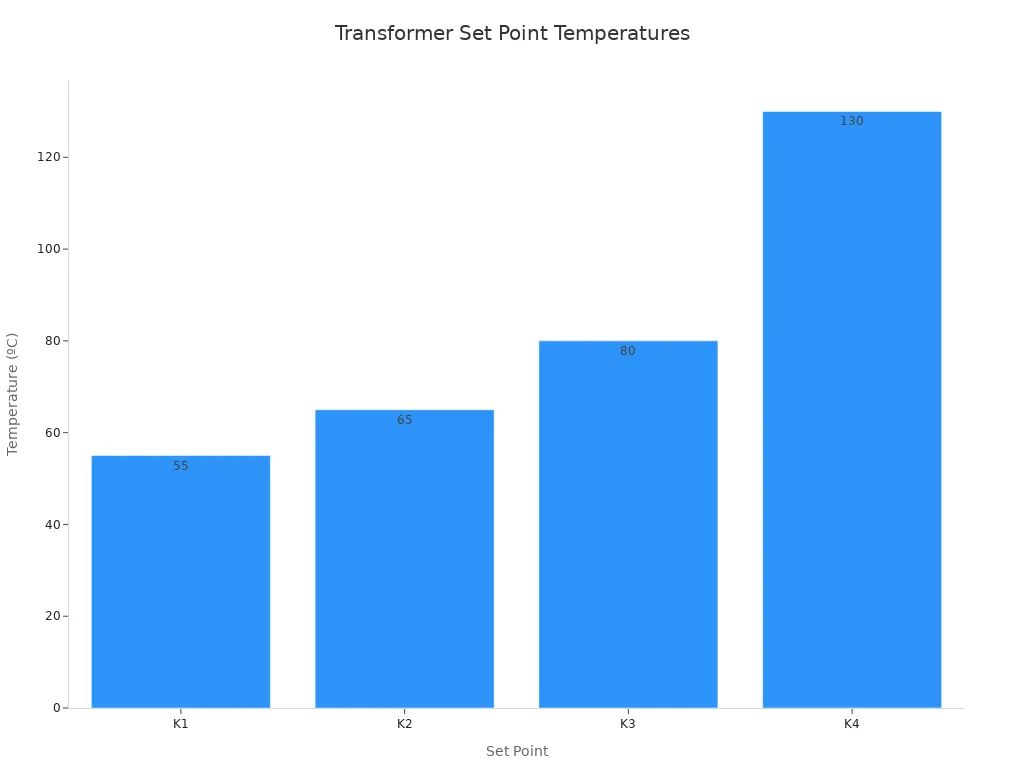
When you set the right points and use a controller with a good switch difference, you keep your transformer safe. You also make sure it works well for a long time.
You need to look at the size of the temperature controller. You should check how deep it can go inside the transformer. The BWY-802/803 series is small. It fits into small spaces easily. Its deepest insertion is 260 mm. This lets you put the sensor near the oil or winding. You get good readings this way. The strong build keeps the device safe. It works well even in busy transformer rooms.
Tip: Measure the space before you install the controller. This helps you choose the right model for your transformer.
You have to connect the temperature controller to other transformer parts. Many controllers use Modbus RTU, Modbus TCP, and IEC 61850. These help send data to control rooms or monitors.
Modbus RTU is good for local checks. It uses RS-485 wires.
Modbus TCP sends data fast with Ethernet cables.
IEC 61850 is used in new substations. It gives quick and standard communication.
You can link the controller to fans and fault relays. If the temperature gets too high, the controller turns on fans or sends an alarm. This keeps your transformer safe and working. Some systems check if fans and pumps work. If not, they send a warning for repairs.
Your temperature controller should work in many places. Outdoor transformers face hot and cold weather. Indoor ones have less change but still need protection.
Condition Type | Specification |
|---|---|
Ambient Temperature | Outdoor: -25°C to +40°C (peaks up to +45°C) |
Indoor: -5°C to +40°C (24-hour average ≤35°C) | |
Humidity | Monthly average ≤90%, daily ≤95% |
Pollution Levels | Level 3: Non-conductive dust |
Level 4: Conductive particles (special units) |
You should check if your controller can handle local weather and dust. The BWY-802/803 series works from -30°C to +55°C. You can use it in most places. This helps your transformer stay safe and last longer.
Strong safety features help keep your transformer safe. The temperature controller uses sensors to check the heat. It looks at the numbers and compares them to set limits. If the temperature gets too high, the controller sets off alarms and trips. Alarms can make sounds, flash lights, or send SMS messages. You can choose the alarm and trip temperatures you want. If the heat keeps going up, the trip will turn off the transformer to stop damage.
The controller checks the temperature and compares it to set points.
It shows the temperature and lets you pick alarm and trip levels.
Alarms warn you with sound, light, or SMS if something is wrong.
Trip actions turn off the transformer to protect it when needed.
Tip: Pick your alarm and trip levels with care. This helps you find problems early and saves money on repairs.
You want your transformer to work all the time. Reliable controllers use dustproof boxes to protect the wires and parts. These boxes keep dust and water out. This stops things from breaking or rusting. Look for controllers with IP55–IP65 rated boxes. These ratings mean the box is strong and works in tough places.
Feature | Description |
|---|---|
Protection from Dust | Stops dust from hurting electrical parts. |
Protection from Moisture | Keeps water out so parts do not rust or short. |
Durability | Built for hard places and lasts a long time. |
Note: Dust and water can break important parts. A tough box keeps your system safe.
You need to keep track of temperature changes and events. Data logging helps you see how your transformer works over time. The controller can save alarms, trips, and temperature numbers. You can use these records to find problems, plan fixes, and make things safer. If you see lots of alarms, you can fix things before they get worse.
Data logging helps you see patterns and stop future problems.
Event records make it easier to plan fixes and upgrades.
Good records help your transformer stay safe and work well.
You help keep transformers safe and working well. Picking the right temperature controller stops overheating. This also helps your equipment last longer. New models like the BWY-802/803 series follow strict rules. These rules include IEC 60076 and IEEE C57, as shown here:
Standard | Description |
|---|---|
IEC 60076 | Design, testing, and performance for power transformers |
IEEE C57 | North American standard for distribution and power transformers |
ISO 14000 | Environmental standards for insulating oils and emissions |
Doing regular checks lowers the chance of problems.
Watching the temperature in real time helps you find issues fast.
Using industry rules keeps your transformer safe and reliable.
Take care of your transformer to get the best results.
A temperature controller checks the heat inside your transformer. It helps you keep the temperature safe. You can use it to turn on fans or alarms when the heat gets too high.
You choose the alarm and trip points based on your transformer’s needs. Most controllers let you set these values using simple buttons or dials. Always check the manual for the best settings.
Measurement range tells you the lowest and highest temperatures your controller can read. A wide range helps you spot problems early. You keep your transformer safe in both cold and hot conditions.
Yes! You can link your temperature controller to fans, fault relays, or monitors. Many models support Modbus or IEC 61850. This helps you watch and control your transformer from a control room.